concept
Party Comedy and Table Banter
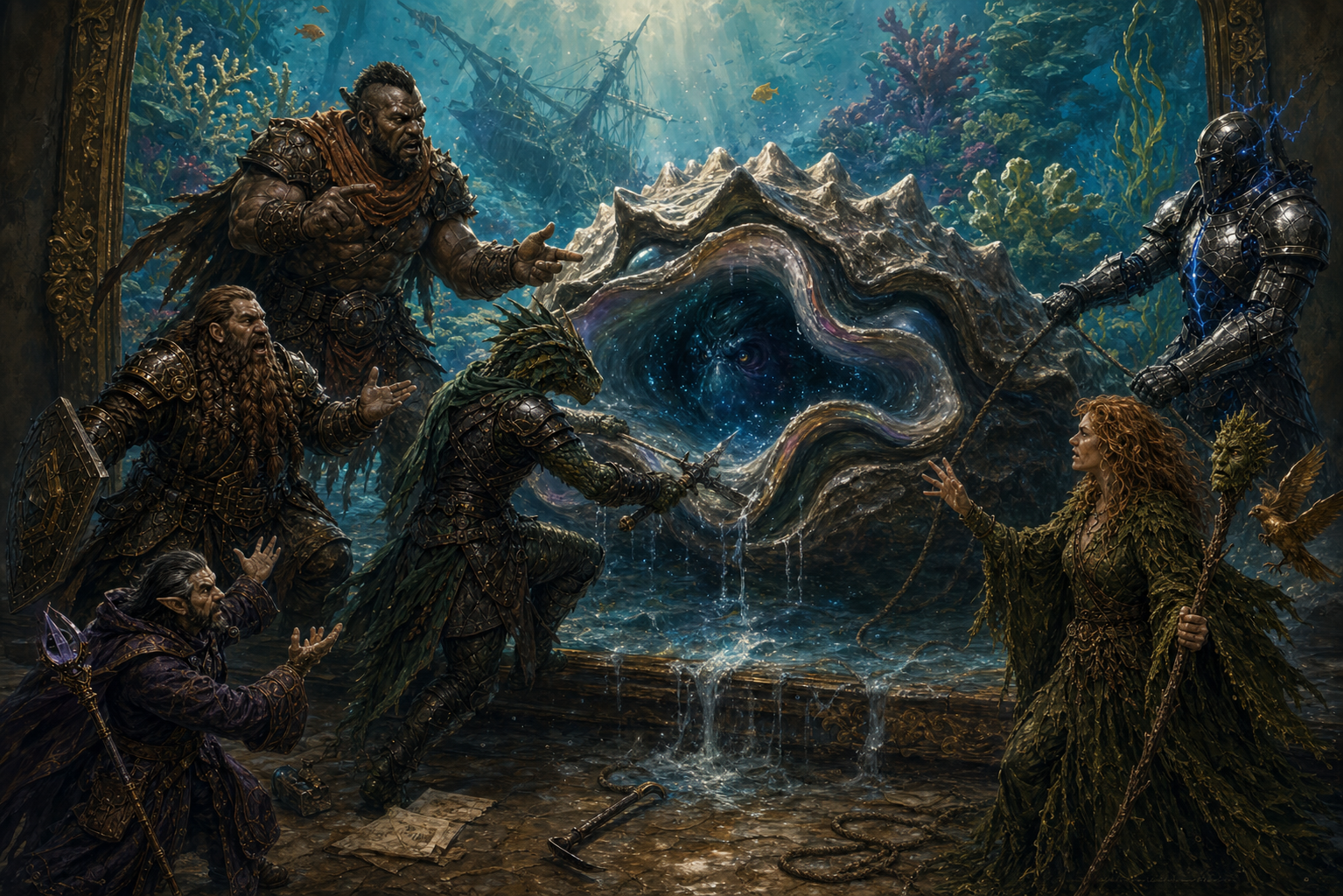
Illustrative campaign art of Eliana escalating a water-painting argument into a practical clam-removal operation.
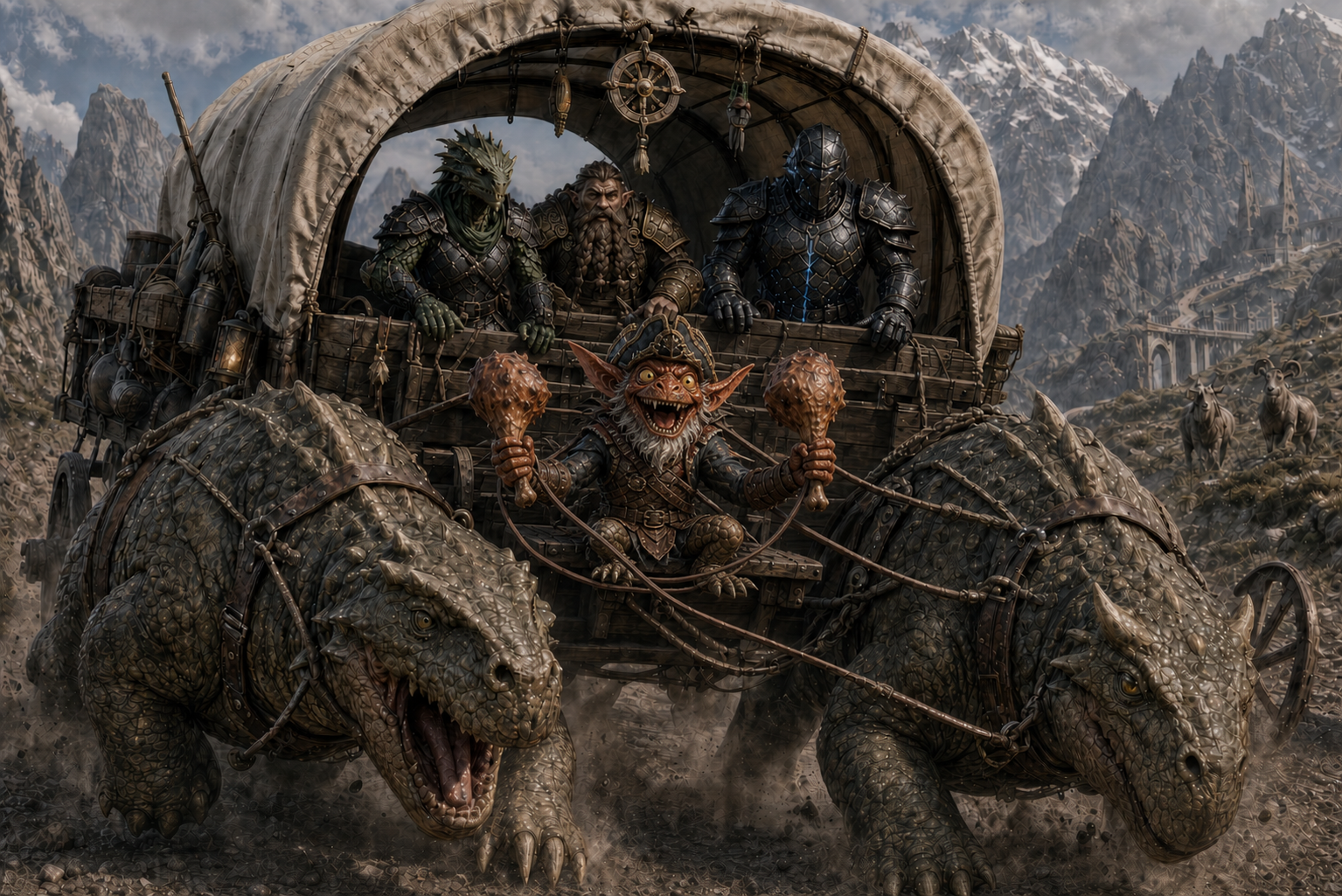
Illustrative campaign art of Bilgewater steering a covered wagon while holding and eating two goat legs.
Summary
The party’s comedy often comes from recurring behaviour rather than formal jokes. The player characters are funny because they treat impossible magical situations as logistics problems, physical puzzles, or opportunities for deeply questionable practicality. Their humour is tied to the same group dynamic that keeps them alive: someone touches, opens, translates, bargains with, or hits the dangerous thing; someone else objects or tries to understand it; then the whole party adapts.
Recurring Comic Patterns
- Meat economics: Colonel Bilgewater Windle the 7th turns travel, payment, honour, appetite, and combat motivation into meat calculations. His worldview makes the Hammerguard road arc especially comic, from meat stops and imprecise counting to agreeing to violence for more goats.
- Dangerous directness: Eliana and Dirk often make comedy by treating strange magical thresholds as things to be tested physically. The result is frequently alarming, useful, or both.
- Practical nonsense: the party regularly converts absurdity into procedure, such as inventing crude checks for illusion bodies or reducing metaphysical weirdness to a workable travel, door, key, rope, or wagon problem.
- Small-town absurdity becoming major plot: early mysteries turn ordinary civic problems, livestock losses, race names, tea-party labels, and local bureaucracy into clues for memory tampering, divine bargains, and identity reveals.
- Fake authority and improvised officialdom: the party repeatedly solves access problems with painted signs, false roles, disguises, bribes, paperwork energy, or the sheer confidence of behaving as if they belong there.
- Magical bureaucracy and curiosity: Geldrin’s interactions with spellbooks, Founder machinery, runes, bargains, and dangerous knowledge often become funny because his delight or focus forces the rest of the party to manage the consequences.
- Sensible straight-man energy: Invar’s seriousness, healing, and assessment of party survival often become comic because he is trying to impose order on situations created by everyone else’s curiosity.
- Action-led deadpan: Dotharl’s comedy tends to arrive through timing, battlefield reliability, and decisive physical action rather than extended banter.
Notable Moments
- Everchard’s missing-pigs problem escalates from a one-gold farm job into missing sheep, absent rats, giant frogs, ravenhounds ribbiting in the dark, and mushroom burgers because meat is not coming in. The joke is not that the threat is unserious, but that the first campaign mystery begins with ordinary town accounting collapsing into swamp weirdness.
- Geldrin’s defining visual introduction includes wild brown hair and glasses with no glass, setting an early tone for brilliant but odd wizard energy.
- Geldrin painted a sheriff sign on a cart during the Everchard investigation, turning the party’s transport into a piece of improvised civic authority.
- Dirk putting Geldrin on the disappearing hatstand in the Barrier Observatory made Geldrin’s clothes disappear, proving very early that the party’s first response to strange magic is often to test it with a party member.
- The party’s racing bets in Seaward involved names such as Wimpy Cheese, Where’s Gravy, The Galloping Salesman, and In It for the Sugar, and the party lost repeatedly.
- Icefang’s vision of Geldrin on a tower made him think Browning could have done with an umbrella, a tiny dry aside in the middle of heavy Barrier and prison lore.
- Geldrin pretending to be a Justicar during the Goldenswell rescue, while a captain read
101 Who's Who of the Penta City Stateswith Scumbleduck in it, captures the campaign’s recurring fake-bureaucracy comedy. - Morgana tried to wake Elementarium with a kiss and received a troubling laughing-dragon vision; Geldrin then hit Elementarium, and Elementarium opened his eyes. The contrast makes the moment darkly comic even though the mystery remains serious.
- Hartwall child-memory labels such as
stupid catandpoopoo headlater become significant identity clues, especially when one sister says, “no, you’re the poo poo head, Eliana!” and pushes the other into a wall. - Failed broom travel sends the party into a blue-sky space with vanishing doors, a speaking squirrel, a brass-looking dragon, and a note that someone thought the dome was a bun while Raelor intended to make the party tea and cakes.
- Bridged’s pathway turns divine travel into escape-room comedy: Invar negotiates cricket, raven, and gruel logic; the cricket becomes Cedric; Medinner will not help because her show is on; the party plays magic poker; the gruel tastes bad; and giggling and sighing orbs become part of the route.
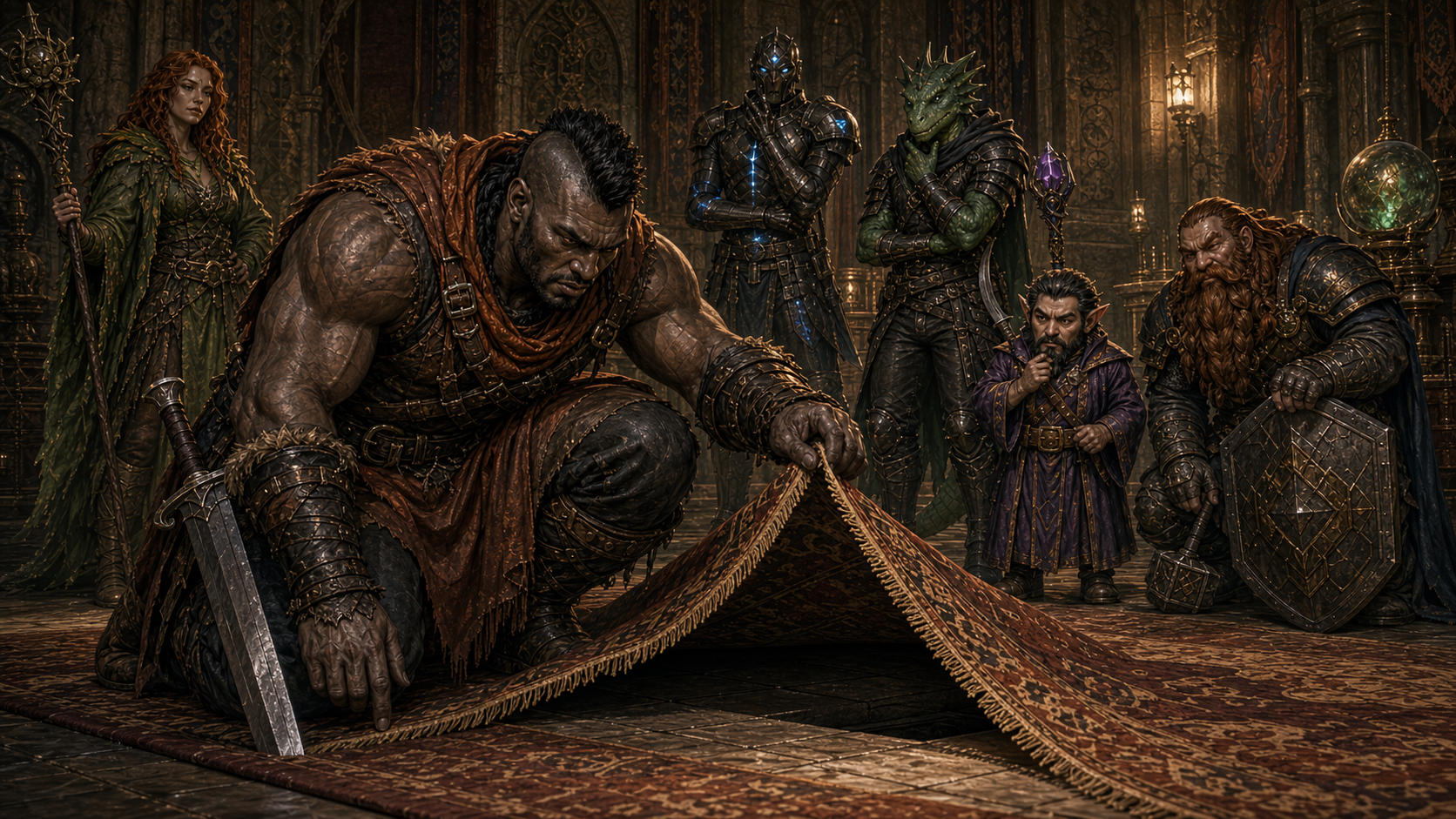
- Dirk looking under the rug “for party justice” captures his practical suspicion: important things are often under rugs, so the rug must be checked.
- Dirk using white paint to graffiti “I was here” turns an odd trade or resource decision into a small act of barbarian archaeology.
- Eliana’s clash with the talking clam in the water-painting realm is comic because she escalates from failed persuasion or refusal into prying, breaking a sword, and dragging the whole clam into the real world.
- The party’s “butt check” for exposing lamia illusions is crude, silly, and functional, making it a clean example of the party solving a threat by inventing a ridiculous field method.
- Dirk’s “good soak after a good smash” attitude distills his comic rhythm: violence, comfort, simplicity, and sincerity.
- Geldrin being called or treated as insufferable reflects an affectionate party pattern: he is brilliant and indispensable, but his curiosity around dangerous magic can be a lot for everyone else to live next to.
- Colonel Bilgewater Windle’s “Two goats now! I can be mad when it’s meat!” turns the Great Tunnel chase into comedy without lowering the stakes.
- On the Hammerguard road, the party tried to turn wagon graffiti into diplomacy, marking a wagon with an anti-Envy or Hammerguard-style symbol while hidden dwarven observers watched from the escarpments.
- The convoy disguise turns infiltration into practical theatre: guards, local workers, kobolds, hidden Geldrin, Morgana appearing to drive the animals, and the dark armoured wagon all become part of the party’s attempt to look ordinary while being very much not ordinary.
- The bear-drawn stagecoach encounter becomes comic because the party’s first plan is not simply to fight, but to pretend a wheel is broken while peering into the coach, talking to the bears, and deciding whether the situation is a trap, a hijack, or both.
- Morgana’s conversation with the giant bears has the same blunt practical humour as the party’s other animal negotiations: the bears say their master feeds them, give no sign of whether they are compelled, and are not obviously tempted by the idea of being fed more.
- The silvery-blue dragon fight turns into disaster-practical comedy when the party wrecks the coach, discovers its floor is full of old silver coins, and Dirk prioritises stealing the silver while the dragon flies higher above the battlefield.
- Colonel Bilgewater Windle’s meat economy continues after the fight: he agrees to guide the party off-road in exchange for goat meat and receives his promised “two meats” as two goat legs.
- Chip, the tiny ruby-eyed earth elemental, adds a lighter note to the Envy planning by turning a secure stone key into a guide who calls Tor his great-grandfather, asks for gems, and agrees to lead the party toward “evil Envy.”
Related Entries
- Player Characters
- Dirk
- Eliana
- Geldrin
- Invar
- Dotharl
- Bridged’s Doors
- Lostvein Noxia Blood and Hammerguard Road
- Hammerguard
- Chip
- Minor Figures
Images